Insertion Sort List
Problem Description
Given the head of a singly linked list, sort the list using insertion sort, and return the sorted list's head.
The steps of the insertion sort algorithm:
- Insertion sort iterates, consuming one input element each repetition and growing a sorted output list.
- At each iteration, insertion sort removes one element from the input data, finds the location it belongs within the sorted list and inserts it there.
- It repeats until no input elements remain.
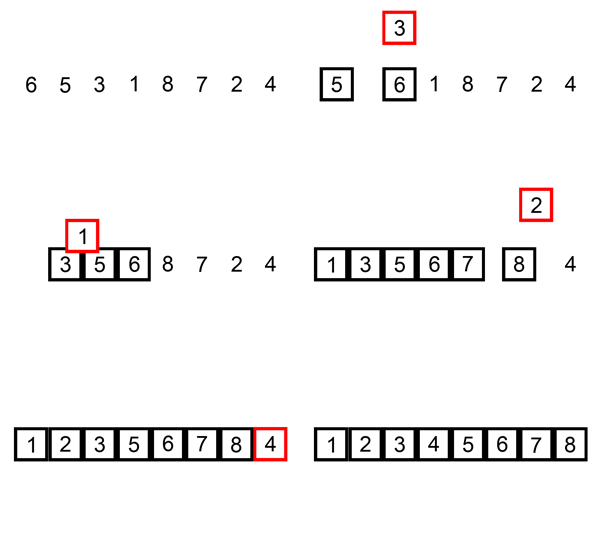
The following is a graphical example of the insertion sort algorithm. The partially sorted list (black) initially contains only the first element in the list. One element (red) is removed from the input data and inserted in-place into the sorted list with each iteration.
Example 1:
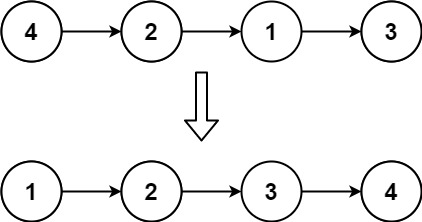
Input: head = [4,2,1,3]
Output: [1,2,3,4]
Example 2:
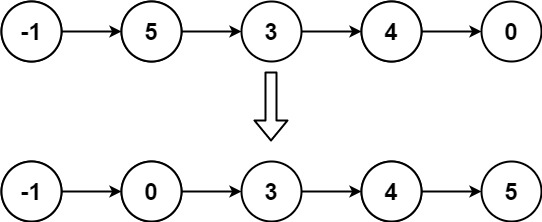
Input: head = [-1,5,3,4,0]
Output: [-1,0,3,4,5]
Constraints:
- The number of nodes in the list is in the range
[1, 5000]. -5000 <= Node.val <= 5000
Solution (Go)
/**
 * Definition for singly-linked list.
 * type ListNode struct {
 *     Val int
 *     Next *ListNode
 * }
 */
func insertionSortList(head *ListNode) *ListNode {
    tail := head
	curr := head.Next
	for curr != nil {
		next := curr.Next

		if head.Val > curr.Val {
			tail.Next = curr.Next
			curr.Next = head
			head = curr
		} else {
			pos := head
			for pos.Next != curr && pos.Next.Val < curr.Val {
				pos = pos.Next
			}
			if pos.Next != curr {
				tail.Next = curr.Next
				curr.Next = pos.Next
				pos.Next = curr
			} else {
				tail = tail.Next
			}
		}

		curr = next
	}
	return head
}