Range Addition II
Problem Description
You are given an m x n matrix M initialized with all 0's and an array of operations ops, where ops[i] = [ai, bi] means M[x][y] should be incremented by one for all 0 <= x < ai and 0 <= y < bi.
Count and return the number of maximum integers in the matrix after performing all the operations.
Example 1:
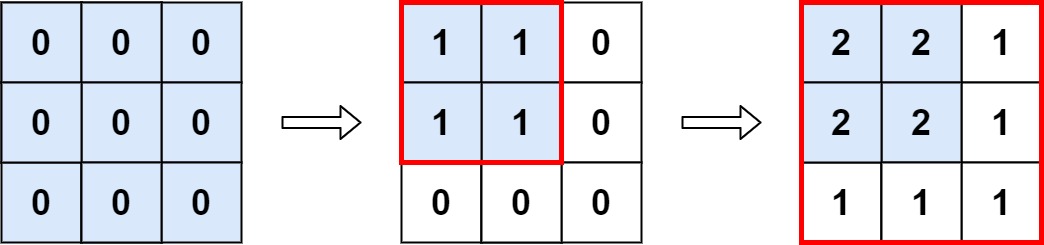
Input: m = 3, n = 3, ops = [[2,2],[3,3]]
Output: 4
Explanation: The maximum integer in M is 2, and there are four of it in M. So return 4.
Example 2:
Input: m = 3, n = 3, ops = [[2,2],[3,3],[3,3],[3,3],[2,2],[3,3],[3,3],[3,3],[2,2],[3,3],[3,3],[3,3]]
Output: 4
Example 3:
Input: m = 3, n = 3, ops = []
Output: 9
Constraints:
1 <= m, n <= 4 * 1040 <= ops.length <= 104ops[i].length == 21 <= ai <= m1 <= bi <= n
Solution (Go)
func maxCount(m int, n int, ops [][]int) int {
    if len(ops) == 0 {
        return m * n
    }
    minA, minB := math.MaxInt32, math.MaxInt32
    for _, op := range(ops) {
        if op[0] < minA {
            minA = op[0]
        }
        if op[1] < minB {
            minB = op[1]
        }
    }
    return minA * minB
}